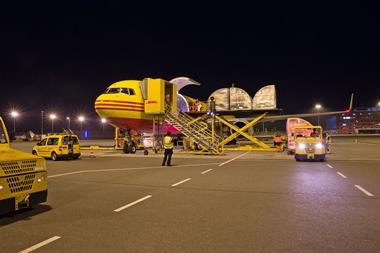



First-quarter 2025 airfreight volumes dropped 3% year on year at DHL, although airfreight business remained “relatively stable”, according to the company.
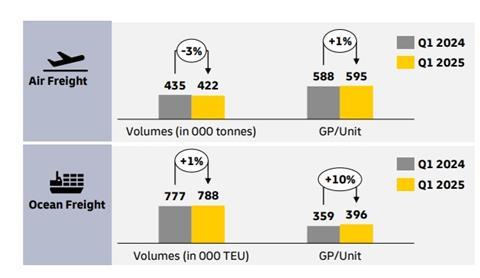
DHL reported that airfreight volumes dropped to 422,000 tons in the first quarter, down from 435,000 tons in the first quarter of 2024.
Compared with its main rivals, Kuehne+Nagel reported a 5% increase in air volumes while demand was flat at DSV.
First quarter airfreight revenue in the Global Forwarding, Freight (GFF) division was up 4% to €1.4bn year on year.
DHL noted it has been fairly well protected from tariff disruption on account of the varied distribution of its shipments.
The Group's China & Hong Kong to US airfreight shipments comprise just 4% of total airfreight shipments, with Europe, APAC and Americas outbound making up the majority of shipments.
In comparison, ocean freight shipments were up 1% to 788,000 TEU. Here too, China & Hong Kong to US ocean shipments made up only 8% of total shipments.
"Volume stable year on year, with increased volatility but no major distortions from tariff speculations," commented DHL.
Total first quarter revenue in the GFF division was up 3.2% to €4.8bn. But gross profit for the division was down 1.8%, lower than the results for all four quarters of 2024.
EBIT for the division was down 23.2%.
However, DHL said: "DHL Global Forwarding, Freight achieved slight revenue growth. The air and sea freight business remained relatively stable. The decline in EBIT is mainly due to economic weakness in the German and European road freight business."
In total, the Group achieved revenue of €20.7bn, up 2.8% year on year. Earnings before interest and taxes (ebit) were €1.4bn, an increase of 4.5%.
Tobias Meyer, chief executive of DHL Group, said: "The economic environment in the first quarter of 2025 was characterised by US customs and trade policy and general economic caution.
"Nevertheless, we continued the positive momentum of the previous quarters with slight revenue and earnings growth. This is also the result of our stringent cost and yield management.
"At the same time, we continue to invest in high-growth business areas while working on structurally improving our efficiency."
Meyer said during the fourth quarter 2024 earnings call that DHL intended to focus more on express air shipments using an integrator business model.
He said: "You see, historically, that Express, the integrator business model has taken share from the carrier forwarder model, and we would, as others, expect that to continue."
In the first quarter of 2025, DHL Express' ebit was up 5%. This was "driven by a ramp-up of cost benefits", said DHL. There was a 5% air capacity reduction year on year in the quarter, including a 4% reduction in block hours. The total weight load factor in Q1 (on average) improved by 120bps year on year, added DHL.
DHL also noted it had strengthened its business prospects in several verticals through a number of acquisitions and investments.
In March, DHL Group acquired 100% of pharma courier CRYOPDP from Cryoport.
DHL also enhanced its e-commerce capabilities by acquiring reverse logistics specialist Inmar in the US and organic investments, particularly in Turkey and India.
Earlier this month, DHL Group established a DHL Health Logistics brand and announced a €2bn investment into its logistics capabilities in the life sciences and healthcare sector over the next five years.