




Air cargo volumes could drop as consumers scale back on non-essential goods, while shippers are favouring shorter-term contracts in a climate of uncertainty.
Niall van de Wouw, Xeneta’s chief airfreight officer, said consumers are looking to save money amid concerns about international trade.
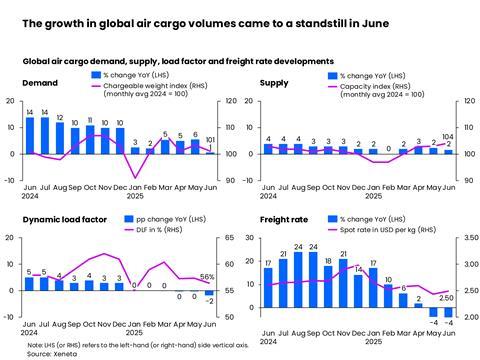
Global air cargo volumes were flat in June, up just 1% year on year, while available capacity, measured over the same period, increased 2%.
Global air cargo spot rates declined for a second consecutive month in June, down -4% year-on-year as supply of capacity overtook demand for the first time in 19 months.
"The air cargo market is losing altitude amidst so much uncertainty,” van de Wouw said. “For consumers who were already under severe financial pressure from the rise in the everyday cost-of-living, the added cost of tariffs means they are more likely to think twice about buying many of the types of goods which are exported and imported by air.”
Despite the disruption from changes to tariffs and e-commerce (de minimis) in the first half of the year, air cargo demand still grew by 3% in that period compared to the same period a year earlier.
But ongoing tariff and de minimis issues mean the industry is likely not to fare as well in the second half of the year.
Lower rates will unlikely be an incentive for shippers, and the focus should be on deteriorating demand due to weaker consumer confidence, suggested van de Wouw.
There are several areas of uncertainty for the market, he pointed out.
The temporary suspension of new US tariffs is set to expire on 9 July for most countries - and on 13 August for China - clouding forward-looking demand.
Simultaneously, a spike in crude oil and jet fuel prices, caused by conflict in the Middle East, has yet to lift freight rates because air cargo pricing remains more tightly tethered to market forces than to input costs, he said.
Compounding this trepidation is a weakening US dollar. As most airfreight contracts are denominated in local currencies, the around 5 % depreciation (across several US dollar indices) of the dollar has diminished the headline decline in dollar-based spot rates.
The global dynamic load factor for air cargo in June reflected the market’s downward trend, falling 2 percentage points year-to-year to 56%. Dynamic load factor is Xeneta’s measurement of capacity utilisation based on volume and weight of cargo flown alongside available capacity.
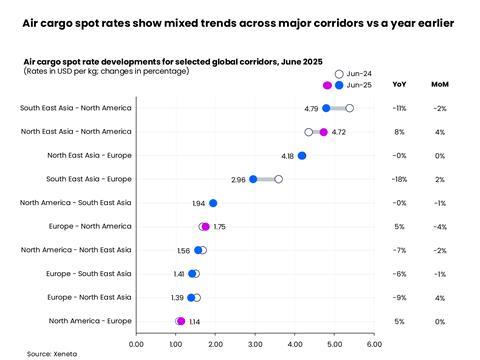
Most airfreight corridors recorded year-on-year rate declines in June, underscoring a broad market slowdown, Xeneta's data showed.
Routes from Southeast Asia to both Europe and North America were particularly weak, posting double-digit drops in rates compared with the same period last year when prices had spiked.
In comparison, the Northeast Asia to Europe corridor remained relatively steady. A surge in e-commerce volumes helped offset a shift in capacity toward the Asia–Europe market, keeping rates in balance.
Backhaul routes from Europe and North America to Asia, however, continued their downward trend, reflecting persistent trade imbalances.
Only a handful of corridors defied the broader pattern. Rates from Northeast Asia to North America climbed modestly, driven by nervousness over the approaching end of the US’ 90-day tariff truce.
Transatlantic routes also edged higher: both westbound and eastbound spot rates posted single-digit increases year on year.
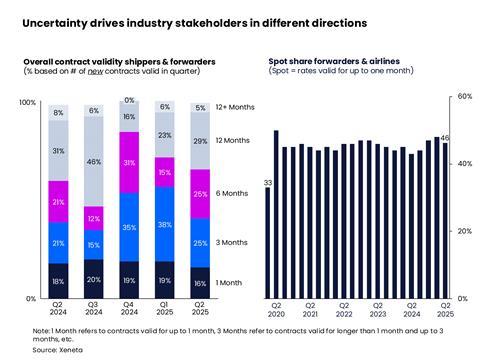
Alongside changes to demand and rates, Xeneta's analysis suggested shippers are now beginning to favour short-term capacity contracts with forwarders over longer ones in the uncertain operating conditions.
The second quarter, typically the peak season for tendering, saw a notable shift. The share of mid-term contracts (three to six months) rose by eight percentage points compared to a year earlier, largely at the expense of annual or longer-term agreements.
That said, compared to the first quarter, the share of three-month contracts declined 12 percentage points. This indicates that some tenders earlier in the year proceeded out of necessity, particularly for shippers who place a premium on service reliability, stated Xeneta.
Meanwhile, freight forwarders are currently opting for capacity flexibility over long-term commitments while they wait to see what will happen to rates. As of June, around 46% of their procured volumes remain in the spot market.